Bath and North East Somerset Affordable Housing Policy

Bath and North East Somerset adopted their Core Strategy inJuly 2014, it says that the “Core Strategy enables the Council to shape the nature and direction of physical change with Bath and North East Somerset”.

Policy CP9 of the Core Strategy sets out the expectations regarding affordable housing in the area, this can be seen below:
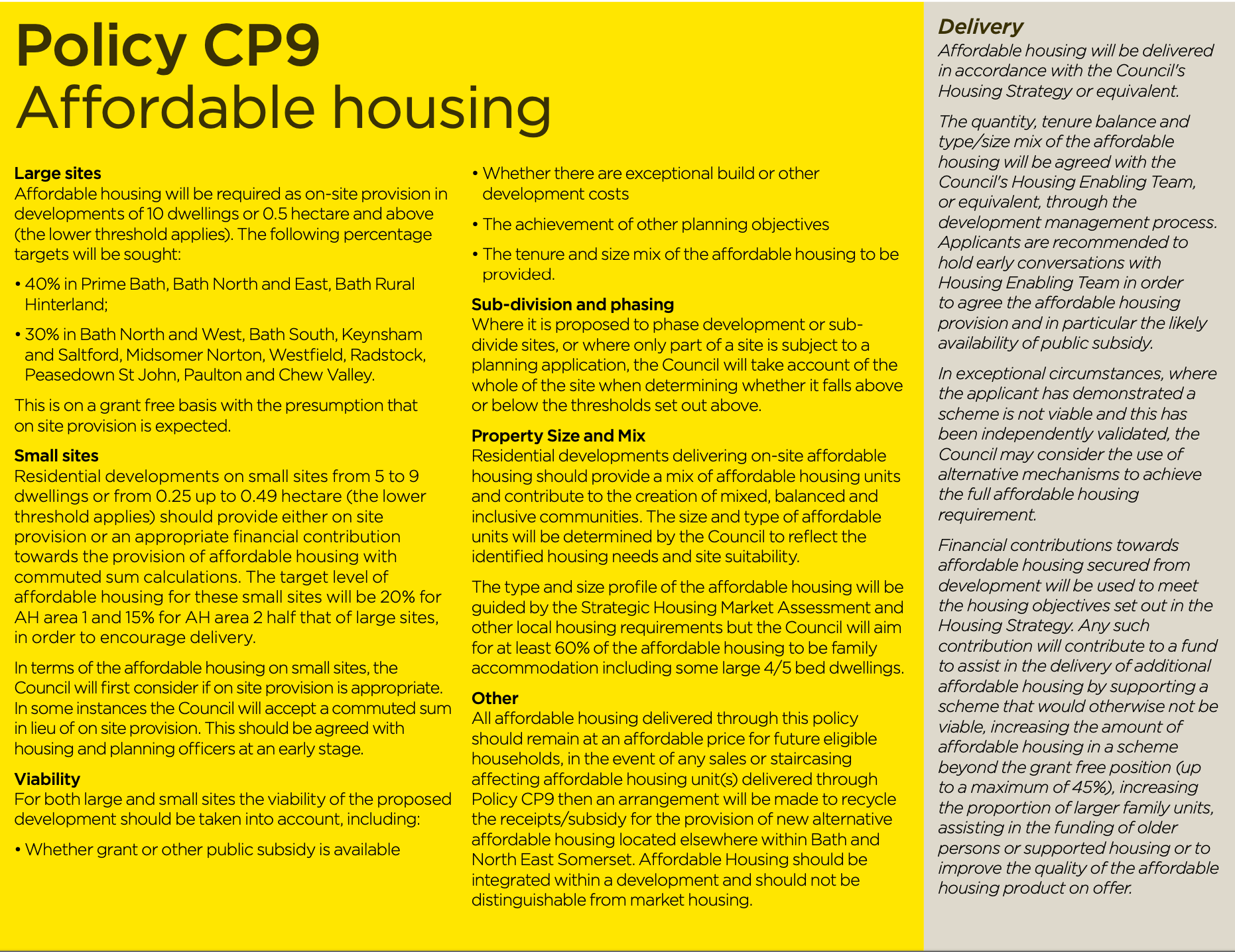
Policy CP9 of the affordable housing strategy.

As seen above, there are different requirements based on the number of dwellings proposed in a development and also various ways of delivering what is needed.

For developments proving 10+ units (or on sites over 0.5Ha), the expectation is that the affordable housing will be provided on-site. 40% is required in Prime Bath, Bath North and East, Bath Rural and Hinterland, whereas 30% is required in Bath North and West, Bath South, Keynsham and Saltford, Midsomer Norton, Westfield, Radstock, Peasedown St John, Paulton and Chew Valley.

For developments providing 5-9 units, the expectation is that the affordable housing will be provided either on-site or as a financial contribution. 20% is required in Area 1, and 15% in Area 2. These areas are the same as that of large sites. The below table outlines the areas in full:

AH Area 1 Prime Bath BA1 2, BA11, BA2 4 40% Bath North and East BA15, BA16, BA2 6, BAI 7, SN14 8 and SN13 8 Bath Rural Hinterland BA19, BA18, BA2 7, BA2 9, BA2 0, BA152 and BS30 6 AH Area 2 Bath North and West BA14 and BAI 3 30% Bath South BA2 3,BA22,BA21,BA25 Keynsham and Saltford BS311, BS312, BS313, BS15 3,BS4 4 and BS148 Midsomer Norton, Westfield, BS39 7, BA3 2, BAS 3, Radstock, Peasedown St John, BA2 8, BA3 4andBA35 Paulton Chew Valley BS40 6, BS40 8, BS39 4, BS39 5, BS39 6 and BS14 0

Any non-policy compliant provision must be justified by a viability assessment. A commuted sum calculation will be required and should be verified on smaller sites.

Given current high build costs and stalling sales values, we advise that a site-specific viability assessment is completed on all developments of 5+ dwellings in Bath and North East Somerset.


Section 106 and Viability: The Basics Explained
June 25, 2021

Section 106 and Viability: The Basics Explained

Section 106 agreements and viability reports are common entities when it comes to getting your planning permission. But what are they, and why are they needed?
The Iran War and UK Development Viability: Why Global Conflict Is Becoming a Local Planning Issue
July 17, 2026

The Iran War and UK Development Viability: Why Global Conflict Is Becoming a Local Planning Issue

Discover how the Iran war is affecting UK development viability, with rising costs, supply chain disruption and planning decisions reshaping projects.
‘Vacant Building Credit’ relief for Affordable Housing – and the ‘in use’ use building credit relief for Community Infrastructure Levy.
July 18, 2025

‘Vacant Building Credit’ relief for Affordable Housing – and the ‘in use’ use building credit relief for Community Infrastructure Levy.

Can a development benefit from planning Vacant Building Credit, or the CIL ‘in use’ building credit? Or is it possible to claim both? The answer is – potentially both.
High Section 106 costs are avoidable

Call us today for a free consultation. Market leader in viability assessment and Section 106 negotiation.

Call us now on
01392 840002
or
Request a call